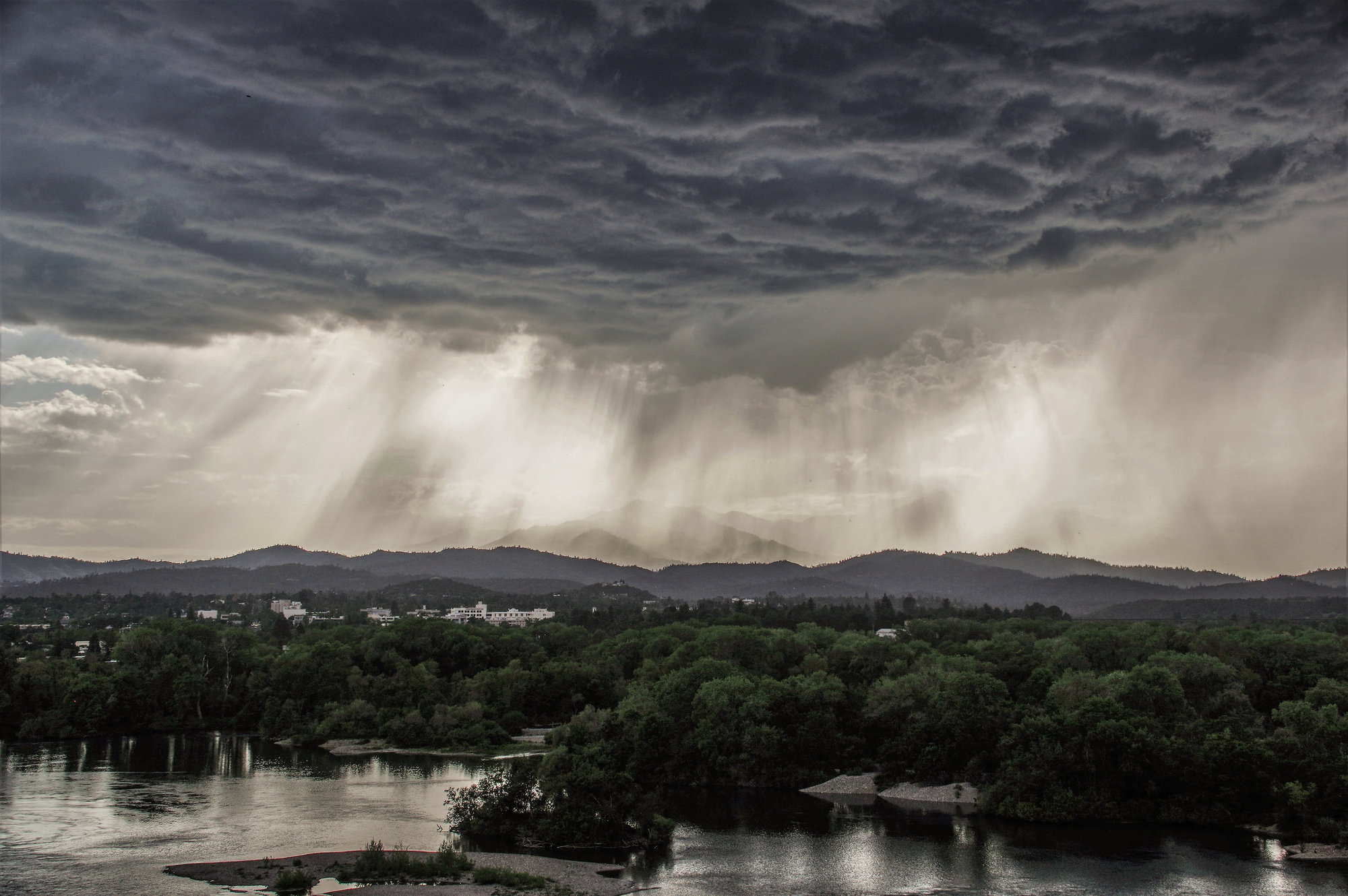
As read in “Someone Asked People ‘What Is A True Fact That Sounds Fake?’ And 40 Delivered Illuminating Responses,” published September 29, 2022, on boredpanda.com, number ten on the list reads, “Humans can smell geosmin (the chemical released when it rains or snows) at 5 parts per trillion. Which means humans are 200,000 times more sensitive to smelling geosmin than sharks are at smelling blood [in the water].” The factoid was found by Bored Panda writers, Ieva Gailiūtė and Ieva Pečiulytė, on the AskReddit thread, “What is a true fact that sounds fake?,” posted September 25, 2022, and as answered by Reddit user, u/spookyskelley, the same September 25, 2022.
Though the specific knowledge has been around for a while, for modernity’s sake: “That smell of rain that we love so much actually has a scientific name, because there are folks who study it. It’s called Petrichor. Here’s what happens: […] think about the soil, or even the pavement of your driveway, with little, tiny holes. We call that a porous surface,” said David Yeomans, meteorologist for KXAN News out of/to Austin, Texas, September 11, 2019.
“A drop of rain hits that hole, it fills the air that was in there, and all those [air] little bubbles trapped in the porous surface, […] they’re dispersed in the air like bubbles releasing from your champagne glass,” Yeomans continued.
“Now, there’s a reason why humans like the smell of rain so much. Apparently, these scientists say, it’s because we’ve evolved to have to know when it rains, or where the water is, because we need water to stay alive. Interestingly enough, we can smell petrichor, or the smell of rain, at the rate of […] several parts per trillion in the air. Sharks smell blood at parts per billion in the water. Bottom line, humans are more sensitive to the smell of rain than sharks are to the smell of blood.”

In addition, when the topic is “Googled,” Google’s “featured snippet” reads “The scent of rain, petrichor, has two main constituents with actual chemical names and origins, -ozone (O3) and geosmin (C12H22O), and humans can sense it at five parts per trillion. Trillion! Which means that humans are 200,000 times more sensitive to smelling geosmin than sharks are at smelling blood,” stated by natural, tallow-based skincare sales website, primalderma.com’s “The Scent of After the Storm” * (pertaining to “featured snippets,” “[Google] display[s] featured snippets when [Google’s] systems determine this format will help people more easily discover what they’re seeking, both from the description about the page and when they click on the link and read the page itself. […] Google’s automated systems determine whether a page would make a good, featured snippet to highlight for a specific research request. [User] feedback helps [Google] improve [their] search algorithms and the quality of your search results,” state’s Google’s “featured snippets” explanation page).
-Also, according to Google’s “featured snippets,” sharks can smell blood in the water at one part per million (which tracks with the math).
More recently, though, Minnesota State Parks and Trails posted a comprehensive breakdown of the smell of earth on their Facebook page, April 31, 2023, clarifying the geosmin and petrichor factoid’s sudden, widespread realization it’s evolutionary wisdom more so than a trending internet interest:
“April showers not only bring May flowers, but also produce petrichor. What is petrichor? It’s the unique and fresh smell associated with rain.”
“Geosmin, plant oil secretion, and even lightning can play a role in that earthy fragrance we smell after a thunderstorm.”
“Geosmin is a compound created by Actinomycetes bacteria [the bacteria that decomposes dead, organic matter, which, in turn, makes “earth,” or dirt]. This bacteria is present in most healthy soils. When rain droplets hit the ground, geosmin is released into the air. Geosmin in the air can be detected by the human nose at less than 5 parts per trillion!”
“Plants produce oils that accumulate in between rocks and in soil. When it rains, these compounds are released, further contributing to petrichor.”
“Thunderstorms also play a role in petrichor. When lightning strikes high in the atmosphere, oxygen and nitrogen molecules are split, and create ozone (O3). Ozone, which has an obvious aroma, similar to that of chlorine, is then carried down by the rain.”
“Rain also helps clear the air of dust particles and aerosols, effectively cleaning the air and making the earthy smell more potent,” states the Minnesota State Parks and Trails Facebook page.
Much like life, it’s a mixture of a lot of things to consider when understanding the smell we’re in.

More information from and about the Minnesota Department of Natural Resources’ Minnesota State Parks and Trails can be found dnr.state.mn.us, as well as their facebook page, Minnesota State Parks and Trails.
Further peer-reviewed references to geosmin and petrichor can be found on Wikipedia pages, “Geosmin,” and “Petrichor,” where citations date back to T.L. Phipson’s April 1891, Scientific American article, “The Odor of the Soil after a Shower.”
David Yeoman’s meteorological report attributions were taken from two separate airings he did of the same weather segment, KXAN’s “The Smell of Rain,” on September 11, 2019. One with a runtime of 1:21 minutes has 4.1 thousand (k) views, while the other with a :52 minute runtime has 18K views, totaling approximately 22k views.
Featured photo online at folkandproper.news, courtesy of earth.stanford.edu.
Other entries on boredpanda.com’s, “Someone Asked People ‘What Is A True Fact That Sounds Fake?’ And 40 Delivered Illuminating Responses,” include number 15’s “Johnny Cash was the first westerner to learn of Joseph Stalin’s death in 1953. He was a morse code operator at the time;” number 4’s, “In 1895, there were two cars out of the entire state of Ohio and they still managed to crash into each other,” (picture included); and number 39’s, “The day that Michael Jackson’s hair caught on fire while filming a Pepsi commercial was the exact middle of his life [Born: August 29, 1958. 9,281 days. Pepsi incident: January 27, 1984. 9,281 days. Died: June 25, 2009].”

Leave a Reply