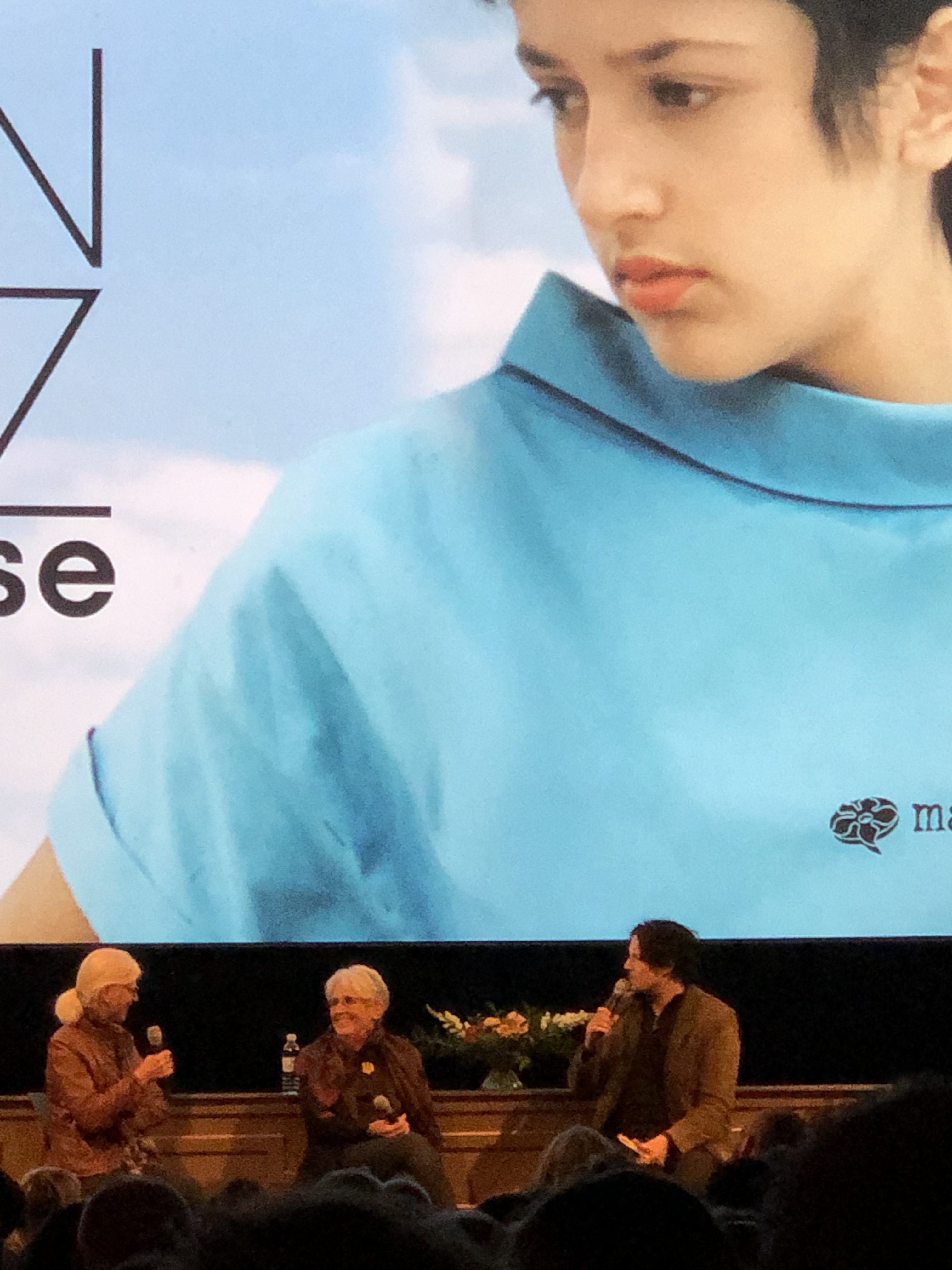
To “a sold-out show of mostly Belcourt members and their guests,” Nashville non-profit film center, the Belcourt Theatre, ran the Joan Baez biopic, I Am a Noise (released Feb. 17, 2023; directed by Karen O’Connor, Miri Navasky, and Maeve O’Boyle) from October 20 through November 9. The opening night included an appearance by internationally acclaimed folk-singer/activist, artist (and film subject), Joan Baez, with I Am a Noise’slongtime friend/director-ambassador for the evening, Susan O’Connor accompanying to further field. They were interviewed by Nashville record company, Third Man Records owner, Nashville producer/guitarist, Jack White. Taylor Swift: The Eras Tour screened in the theatre to their left. Talking Heads’ Stop Making Sense screened upstairs, above their heads.
The Joan Baez-assisted biopic, I Am a Noise, touches on a few key/several major pivotal/defining occurrences, respectively, in Baez’s personal life, as well as musical and humanitarian careers through the eyes of the director/producers spanning from a nurtured, seemingly, jovial and musically-motivating childhood through Baez expanding her late-50’s/60’s traditional folk training through the Cambridge, Massachusetts scene, her Newport appearances, ”meeting Bob,” and then onto somewhat onto neuroticism through family life, philanthropy starting Amnesty International, and her hypnotherapy sessions in her 50’s (the early-90’s). The movie was initially tact Cinema Verite (kinda, turn the camera on and let the story make itself) during Baez’s 2021 Farewell Tour, but eventually evolved into a lovely, yet revealing “swan song,” all in the 1925 theatre of the Belcourt, October 20, 2023.

*The Belcourt’s Allison Inman, Education and Engagement Director, spoke preface:
“You know, we’re a nonprofit, independent movie theatre, and we’ve been showing movies, -in this very room, since 1925, so we’re building up to our 100th anniversary, and we just can’t say enough how much we appreciate your support, and we also hope that you’ll participate in our Belcourt Stories project, as we’re gathering oral histories and videos from you. You’re part of our story. So, just go to our website and check that out. We’re doing a lot of fun things to lead up to 100 years,” Inman said.
“It is also just amazing to have Joan Baez with us this evening.”
(audience applauded).
“I wonder, was anyone here on March 24, 2004, when Joan Baez played on this stage? I’ll give you a dollar? (Spots someone) Yeah? Me, too! -Thanks for coming back.”

Baez/White/O’Connor interview, post-I Am a Noise:
Karen O’Connor, director: Um… Thank you all for coming out. My co-directors and I have designated me as kind of representing the filmmakers, largely, just because like all of you are eager to hear what Jack and Joan have to say together, but I would like to acknowledge my co-directors who are here, Miri Navasky and Maive O’Boyle. Would you guys take your nod, please?
(Miri and Maive wave).
O’Connor: Also, just wanted to thank our creative team. We were lucky enough to have some incredible cinematographers: Wolfgang Held, Ben McCoy, Tim Gruzca; our incredible composer, Sarah Lynch; graphics by Connor O’Boyle; and our animation team from Dublin, Eat the Danger. Also, happy here tonight, we have some of the Parnassus team here tonight. …Sarah (audience ‘awwwww’d in the camradarie) …Parnassus is my favorite bookstore, although I read the New Yorker [now assists?] it. So, like the Belcourt theatre, you guys are really lucky to have these beacons here in Nashville, so our thanks to Belcourt staff for this incredible welcome to your beautiful theatre. And certainly, last but not least, we are thrilled, -we’re honored, the kind of, woman of the hour here tonight. Please welcome Ms. Joan Baez and Jack White (audience erupts).
Joan Baez, walking out from the fire exit, stage right : All right, I can’t see you either.
(Crowd laughs).
Jack White, following in/sitting down: Is this on? This working?
White, comfortable: How’s everyone feel after that amazing moment?
“God, I want to watch it again. I’m ready immediately. It feels so good. It was so deep, and so, -also funny, and also so vibrant, and it reminded me of how many different styles of songs I’ve heard you sing over the years. And I did some research about it. I didn’t realize that you had recorded a couple albums in Nashville in ’68.”
Baez: Both early-early, and then later on. The early ones were Really early.
White: What brought you here in ’68? What was the reason for that?
Baez: Umm…The musicians (audience slowly applauds). It was no big deal [and] it was a no brainer…
White: -Some of them are still here, though (crowd giggles).
Baez: There are some of them still here.
White: Thank you… Um. Did you feel, -at that time in the sixties, did you feel like there was a, -that the folk scene was spreading out to different genres? That the country was rearing its head? Obviously, the Blues and the older songs were there, but… What direction did you feel at that point? Compared to ’62 to, maybe, ’68? Did you see it going in a different direction heading into the ‘70s?
Baez: Well, it was. Yeah. I, personally, was a very narrow-minded, little folkie. And for the first few years really, though, that folk music, -traditional music, had to be handed down from your ancestors, and your great grandparents. You couldn’t read it somewhere. That disqualified as folk music, so I had a long way to haul out of that as we moved towards different kinds of music, songwriters, and then eventually, of course, the invasion from Europe, which eventually began to merge folk music and whatever you want to call rock and roll, -pop. Y’know.
White: Were you getting…ehh… How about Harry Smith’s Anthology of American Folk Music? Did that come into your being early on? Do you remember when you encountered that?
Baez: No. No, I don’t remember, but I know the books about that time period. When I was around, early on, there was still people out going out into the hills and recording, y’know, folks who have never been seen or heard before. I went out on one of those, -it was for Doc Watson’s people… -different singers. And at Doc Watson’s place, there was a quilting bee going on, and it was all these women who were quilting and spitting into a golden spittoon (audience laughs).
White: So, where were you hearing a lot of the songs, that you ended up coming because you played so many kinds of folk songs? Where were you picking them up at? Was it musicians? Was it records?
Baez: Musicians. Records. I think I said something about I got a jump start in Cambridge, because the coffee shops… There were a lot of coffee shops. It was a sudden explosion from jazz into folk, and I would just hang around my favorite club, which is Club 47, and copy, -just ask them, ‘Can you teach me that?’ ‘Can you teach me that?’ -Just beg, borrow, and steal until I made a song my own.
White: There’s something more special when you learn from another person, y’know. One on one… [rather] than [repeating it by yourself] over and over.
Baez: If they’re patient enough (crowd chuckles), yes.
White: So, you were in Boston a lot the time. Were you driving down to New York and hitting the folk scene from Boston? How did you…
Baez: No. Actually, it was Cambridge where my center of music was, -and activity. I went to New York a couple of times, but I didn’t spend a lot of time there. It is where I met Dylan for the first time when I saw him a dirty folk singer, -folk….
White: …And Dylan is folk singer? (crowd laughs).
Baez: He is…, -Actually, he was a famous ragamuffin, is what he was (crowd laughs).
White: How did you make a decision to, sort of, open up and allow so many personal and deep things in your archive and your family history? I mean, how did you decide to do that? Y’know, that’s such a difficult decision.
Baez: Well, I had coaching from my friend, here, Karen, I’ve known for decades.
-There’s one little snippit in there that was an old interview we did, really, what, …30 years? (Karen ‘yeah’s’ in the background).. Jesus (crowd laughs). Um, anyway, so we had talked about this periodically, about filming the last tour, -or filming something in this life, and it made sense to film the last tour not really knowing if I was going to end it (her music), because that would be just as interesting. What is this 70-something, or -mehhhhhh, 80-year-old-whatever deciding to do with her life at the end of the sixty year career, so, -well, you take it a little bit from there (Baez motions to Karen O’Boyle, to her right).
Karen O’Connor: Yeah, so, Marriane, Maive and I started with the farewell tour as a potential narrative anchor, then maybe then more of a Verite film where we would follow Joan on her last tour, and then that evolved over time, particularly when we kind of hunkered down for a month in California. Marrian and Maive brought their families and we started to go through Joan’s house and saw this, kind of, incredible archive. Every drawer you’d open, you’d find these letters, or you’d find a letter that she wrote to her parents about the Beatles, or you’d find… -y’know, as if her house itself was filled. And then she gave us, literally, the keys to the storage unit, so the scene in the film when she goes into the storage unit for the first time, -it was the first time she’d actually ever been in the storage unit, so once Marianne, Maive and I, -I knew about some of the material, but when Marianne, Maive and I got into the storage unit, it changed the film completely.
Baez: And then it was the decision to “leave an honest legacy,” meant leave an honest legacy. And, so, I didn’t even want to do what they were doing going through this stuff. Some of this, I’d never seen before… I mean, the writing from the psychiatrist when I was, y’know, little, and …tons of it. Some of it I remember, but I hadn’t seen it, or haven’t seen it ever, or am re-seeing it. It’s a huge learning experience for me, and each time I would think, ‘nehhh, I wish I didn’t have that in the film,’ (before or after I saw it, [that] I didn’t want something), and then I realized that it was that part of making this film what it is, which is kind of a classic, already…
O’Connor: And you’ll appreciate the kind of ‘act of trust’ it was, Jack. Joan did not have final cut, so it really was…
Baez: I didn’t have half-way cut (crowd laughs)
White: That’s brave of you. (crowd laughs).
O’Connor: So, some of the celebrity docs can be carefully curated and controlled and then sort of bury these lines between the subject… so, for Marianne, Maive and I, it was really important that we had a little bit of editorial firewall so that its…
White: That’s wonderful. Yeah.
O’Connor: …a film about Joan, not Joan’s film. On the other hand, it was a the most intensely personal film.
White: It gets two things, -It’s like, it’s nice to have something that’s nice like this that could happen to someone like you (motions to Baez); that could happen while you’re still alive rather than 30 years after you’re…. which I’m sure you’re gonna be around until you’re 110 years. There’s no doubt about that.
Baez: Whoopee…
(crowd laughs).
White: But also, then… a lot of people making films out of base where they are totally in control of it. They’re making, sort of, this revisionist history and its quite painfully obvious to the people who are fanatics of what they do…
Baez: Yeah.
White: …it’s kind of unhealthy. It’s kind of a strange embracing of ego that we, -that we too could take a break from.
“Yeah, Karen says, -I have great courage going into bomb shelters Hanoi, touring in the South facing the Ku Klux Klan discouraging black America with the tear gas, but the real courage came when I said I’d make this film in natural light,” Baez said.
O’Connor: …And there wasn’t a key light anywhere.
White: I have to say, though, …I’m -I’m not just saying it. You are more beautiful now then you were when you were 25… (editor’s note: White looks to the audience seemingly joking, “[she’s] supposed to hand me a ten dollar bill, right…” but then seemingly realized that was inside-his-head humor and where he was, then looked down hoping no one heard it before quickly on to the next question. It all happened so fast, but hilarious).
“It’s so beautiful to hear you and see so much footage of you singing with your sisters, -especially Mimi. I [have] a piece of footage of you guys singing, I think it might have been the Bolivian nation anthem, at Sing-Sing. What was that?” said White.
Baez: It’s Sing Sing, yeah. It was the Bolivian national anthem (she was chuckling).
“I don’t do national anthems, but that song is so great, plus I didn’t realize what it was (crowd laughs). I was just doing it phonetically. It was just beautiful, but yeah, that’s what it was,” said Baez.
White: Well, I remember hearing a while back, -I can’t remember who it was talking about, but it was someone saying there’s a special harmony that only comes from family members, where, y’know, you’re sitting in bedrooms or living rooms together, and you’re in each other’s faces all the time. Its not the same as people who are amazing singers, who are -there’s probably forty of them in this room, at least, and will come into a studio together, -and who’ll harmonize (you’re able to do it), but to grow up together, that you’ll know, -you’ll know exactly the way the other person attacks the note, or does a lilt, or has a crescendo, and it’s kind of… You can’t create that.
Baez: No, you really can’t. And there’re only one other person who isn’t even know that can really, -even come anywhere near that. You breathe at the same time. You sing the note the same length, and, yeah. I miss that little sister.
White: There was a, -I read somewhere you had a mentor. What’s his name, Sandpearl?
Baez: Ira Sandperl.
White: It got me thinking about, -well, if you’re going to speak a little bit about that. I don’t know anything about that relationship, or what that mentor was like, but I find its something I keep coming back to, nowadays, thinking that it might be something sort of missing from modern times, and this idea of mentorship needs to come back. I think that reflects a little bit, too, in the folk scene, passing the songs from one to another, passing knowledge from one to another. Speak about that if you have any…
Baez: Well, regarding Ira, that’s in the other world of passing along, and was a mentor, and he taught me what I needed to know about non-violence to which I was so attracted, but didn’t really know that much about it. Then we started with reading, and then realized I wanted us to start an institute for the study of non-violence assuming if we had other people there, we would learn more, which is what happened. So, this afternoon, the Institute for the Study of Non-Violence closed, but it was taken over by the Resource Center, and I called, and I said, ‘give me the statements that you’ve written for the Middle East,’ y’know? -There are some, actually, and they have to do, -still, with how we treat each other. And nobody in our community of non-violence pretending we can solve what’s going on, now, but suggesting that we not have the first reaction always to be violence, and, so, begin tuning our minds, and then what we can do about… I’ve already posted a bunch of these things. I’ll post a bunch of possibilities for what you[‘re] to think about. I’ll put them on my website and Instagram.
White: In hindsight, what it looks like is you’re at the ‘I Have a Dream’ speech, and on those marches, it’s so idyllic start to wonder, ‘well, maybe it wasn’t as idyllic as I’m seeing the footage all the time. Did it feel like when you’re in those moments standing next to Dr. Martin Luther King and those amazing moments you had, -and I’m so glad so much of that is in the film that people can see it, were you feeling like, ‘Wow, we really have a chance to change something,’ or were you feeling, ‘man, this is really, -really, a tall mountain to climb, right now.’?
Baez: No. I felt two ways: one was it absolutely exhilarating to see the bravery, the actions and the activities, and the thought and the prayer, that was, and still is, a feeling that’s absolutely marvelous. And then, looking back, I feel also is though all that happened, even though there’s a struggle now to erase it all… I mean I never thought I would live in an atmosphere like the one we’re living in, now, -not just here, but everywhere… um, but to remember that those moments of people at the lunch counter being beaten up and saying ‘You can cause me suffering, but I won’t cause you suffering,’ -those are part of the fabric of our lives and of this country, and that’s something to be remember and celebrated, even in the midst, -or maybe Because we’re in the midst of what we’re in, now.
(Audience applauded).

White: Editing in the film was really superb, and the flowing is great. It’s not exactly linear. It jumps back and forth, and it flows really well. And it helps paint some really interesting pictures. Those were all your drawings, I’m to understand?
Baez: Yeah. They were all my drawings.
White: That’s pretty good. Some of them were amateur [and] some of them, you could do a little bit better…Eight year old you? Needs a little…
Baez: (laughing) …needs a little work. (audience laughs).
White: They were wonderful. Those are actually my favorite. […] I love the younger stuff. It’s very cool to see how your mind was working at that time. But I love the way you animated that, too. Was that difficult? What’s that like to incorporate animation when you’re editing like that?
O’Connor: First off, a big nod to our editor Maive O’Boyle for her genius editing.
(Audience applauded).
“And Yes, the animation was a big decision. Marion and Maive were ahead of that. Actually, I was, -although I absolutely love the animation in the film, initially I was concerned some animation can be Disney-like and can take you out of the film in some way, but we cracked the code with Eat the Danger (Dublin animation company), which was to use Joan’s original artwork as a kind of artifact, and they were blown away by her artwork, and the guys are genius. So, they found a way for her drawings to come alive rather than animate Joan’s drawings, if that makes sense. Once that happened, it was just wonderful, and opened up where, and how we could use it. The drawings, like every element in the film, had a narrative trajectory, so yo see the young art to the old art; so you see the early audio tapes to the old. It was very helpful in editing,” O’Connor said.
White: Did you transition at some point from drawing into painting? Have you always painted, or was that something that happened later on?
Baez: It happened later on. I’d always, y’know, meddled around with paint, but never gotten serious. I guess it was 13 years ago, now? Yeah, all of a sudden, got the bug and went into an art store and said, ‘show me this,’ whatever. Then, went to a local artist and I said (gruntingly), ‘Just get my hands in the thing. Get me started.’ And she squirted some acrylic on the canvas, and I just started with just collages. Then one day, a couple of years in, I thought, ‘I’d really like to do a portrait. I bet that’s really hard to do,’ and it Wasn’t, -for me, anyway. So, I’ve started doing portraits, so that’s what I’ve done. I call them Mischief Makers, and they’re all portraits of people who’ve done social change to denote non-violence.
O’Connor: Including you there, Mr. White. Have you seen that?
Baez: Oh, yes, by the way. Oh, you should’ve brang it with you. I did a beautiful portrait.
O’Connor: It’s one of my favorites of hers.
White: That’s an honor. That’s an incredible honor. …Well, it’s nice to see there are regular ways you’re creative on the daily, and I know you’re not playing shows anymore, you said earlier?
Baez: Nnnope (audience laughs).
White: How about guitar around the house? You still playing guitar?
Baez: Not around the house. Or outside the house (audience chuckles).
“Actually, I did a show, -took part in a show, about a half-year ago, or something, and it was a big decision because the guitar Is hanging on the wall. -You see, [when] I hung up the guitar, I had hung up the guitar, and then I thought, ‘okay, we’ll see if these fingers can still work and see whether the voice can crank out something I’m happy with, -and I was medium happy with it. But it’s something I have to work so hard at to get the sound something fluid and something I like. I’d rather be painting and drawing, and [I’ve got] a book of poetry coming out this spring (audience applauded). It’s called, When You See My Mother, Ask Her to Dance (audience either shuffled loud or slightly gasped). That’s the title…,” said Baez.
White: Well, you’re an incredible guitar player, so I don’t want that to stop. I took me back, I was pointing out some guitar playing that you did, -the finger picking stylings you’ve used over the years, you know your instruments so well, especially at such an early age, too. It got me wondering about other things that were going on.
“You started like a lot of folk artists did at the time, covering a lot of older folk’s songs and carrying them onto the next generation, some of which were, like, ‘Babe, I’m Gonna Leave You,’ and ‘House of the Rising Sun,’ went on to become gigantic hits for bigger rock bands down the road. Was there a time when you said ‘I want to start writing my own songs, now. I want to start adding to the pantheon, here,’ or was it considered something that wasn’t to be done at the time? Was it a dangerous move?” White said.
Baez: No, I just never thought about it. And somebody said, ‘You should start writing songs,’ and so I started writing songs. I wrote ‘Sir Galahad.’ That’s the first one I did and also kinda liked it and said, ‘Oh, I’ll do this for a while,’ and I did for a number of years, and then, 30 years ago, -it’s interesting: it just stopped. I didn’t stop it. The words stop coming, and the melody, suddenly, and I said, ‘okay, it’s time to move onto something else.’
White: How many other people around were writing their own songs at the time? Was it common?
Baez: Well, it depends on the early… In the very early days, no. Not very many. There’re two, I can’t remember their names, right now. And then, there was some around Rick Von Schmidt and, can’t remember other names. But then the real flow of it, I think, probably came with Bob, because people were imitating; trying to be; trying to write the same way, and out of that flood came some good music.
White: Its really nice that they were able to crack that mold, or it just could’ve been that kind of, ‘you’re not allowed to do anything.’ There are certain kinds of genres of music, to this day, where you’ll go and see a certain festival of a certain genre of music and it can be very, ‘this is old-timey,’ or this can be ‘such-and-such’ a thing, and people who try to break the mold are kind of ostracized. So, it’s nice to see those moments. I always gravitate to those because I want to ask about them because I want to know what it’s like at a particular time. Were people trying to talk you out of it, or encouraging it?
Baez: No, I think that the early Newport, like that one [in the film; the early sixties’ Newport Folk Festivals], there were tents, there were different groups, there were blues and gospel and bluegrass, and everything. And we did all. It was a melting pot for all of us. I didn’t know at all that you could go from group to group, but actually in those days, I’d feel very welcomed at all the different groups.
“There’s legends that were at those festivals at that time, where you see this footage, …it’ just mind-blowing that Sun House is in. Howlin’ Wolf, Blind Willy McTell, Black Woody, Mississippi Fred McDowell
Baez: Memphis Sun [Records]…
White: …Who did you remember you encountered who were enlightening to you at the time?
Baez: Well, they were all enlightening in one way or another. I remember…(giggles) the “dirty, old blues singers” (reaches out to Jack White to comfort him) Excuse me (to White). But, they came out of different roots, y’know. “Blind-somebody” came up and said, ‘Oh, I want you to meet… (to herself) what the hell? Which one was he? I can’t remember, (to White) but this Great blues singer came up and they said, ‘we’d like you to meet Joan Baez,’ and he threw his hand on my chest. I said, ‘okay, that’s good enough. You go sing,’ y’know?
O’Connor: Were you there… When you… When Dylan went electric, you stood by him, and just to your point, check when he started to…
Baez: No, I didn’t. I was horrified. I was just like Pete Seeger, -I was as mad as Pete Seeger! And that’s who everybody was talking about! ‘What a squaaare [Seeger] was he couldn’t take Dylan changin’ out,’ and I was thinking, ‘Oh, my God, we’re losing him,’ y’know. But then Pete, and music, are a funny thing because last time I saw him, eight, nine, ten years ago singing around where he lived. He came to the show, and afterwards he said, ‘Do you need to have all those drums?’
(Audience and O’Connor laughing).
O’Connor: (laughing) I said ‘to your point!’
Baez: He also said, -because people are always saying to me, ‘Who are the young groups you listen to?’ And I can never think of them at the time, but then I think, ‘Oh, but I don’t listen to them enough. I don’t know them enough and I feel stupid,’ or whatever. So, they ask Pete who he’s listening to and he says, ‘well, the only music I really listen to is when he takes his grandchildren to the ice skating rink.
White, ‘ah!’, and the audience chuckle.
White: What’s your take on modern singer/songwriters, whether they’re pop musicians, or underground, or folk, these days? Do you find yourself, things catching your ear and you’re feeling excited?
“The young ones? You mean like Jack White? I had you on repeat. On loop! To try and get it all in there in the last few days. Big buddies with Lana Del Ray, you know, looking into the younger minds. She’s a friend. She did a Q&A for us when we were in L.A. And my granddaughter is 20, and she’s a huge fan of Lana and Phoebe… Phoebe Bridgers. As am I. I’ve been asked to give the award to them, I can’t remember what it was, but anyways, -to BoyGenius in L.A. in December, I said, ‘Yeah, I’ll do that,’” said Baez.
White: Throughout the years, have you ever been approached to be in a band with other musicians and make something larger out of what you were doing, or was always your thing to be solo?
Baez: Oh, it was solo, plus, I don’t play that well. I mean, I don’t play that kind of…
White: Disagree (crowd chuckles).
Baez: I play folk music. And I realized if I were somebody like Bonnie Raitt, Jackson… They all play. They play different tunes. I do… I do chords, and I’m, hanging out with Dirk or Gabe before a show, and everybody, -the two women there, they’re all playing this cool stuff on the guitar, and I would not be worth shit in a band, that’s why…
(Audience laughs).
White: Lot of compromising, that’s for sure. Some can do it. Some can’t. …But I’m glad that you get it in a lot of ways because the specialness of you really shines and it needs to have that one person against the world, which is the way I’ve always felt that the blues really is, and whether its folk, or hillbilly music, or whatever its been categorized throughout the ages, but what you are doing is one person against the world, and I don’t see any victimhood in what you do. I don’t see any false pandering in what youre doing. What I’ve always witnessed and heard from you is that you really meant it, even if it were some hundred year old Irish ballad, you inserted yourself into that and sold it to a new group of people to turn them onto something, so I want to thank you for that person tonight.
(Audience ovates).

White: And that’s all I got to say.
Baez and O’Connor: Thank you. Thank you so much.
White: Thank you so much for coming to Nashville. We enjoyed it.
(…As patrons filed out to the growing restroom lines : “Thanks everybody. If you could just exit out the back doors, we appreciate it,” warmly directed the staff).

And as for the Belcourt, an upcoming, area-inspired event, -this time in affiliation with WPLN/Nashville Public Radio, “join us at the Belcourt on November 29 for an onstage discussion of The Kids of Rutherford County with WPLN’s Meribah Knight and Madeleine Baran, host of the award-winning, investigative podcast, In The Dark,” states wpln.org.
To learn more about and listen to “The Kids of Rutherford County” podcast from Serial productions, The New York Times, and WPLN’s Meribah Knight, as well as find tickets to Behind the Podcast – A Conversation About “The Kids of Rutherford County,” onstage discussion presented by Nashville Public Radio, November 29 at 7 pm, at the Belcourt Theatre, visit wpln.org, and belcourt.org Doors ope
Further reporting on the Rutherford County Criminal Justice system of that time can be found at Bryce Harmon, Author at The Murfreesboro Pulse – Page 4 of 7 into the next, or “newer entries” button to, Bryce Harmon, Author at The Murfreesboro Pulse – Page 3 of 7. Apologies for the clutter. The first one begins Navigating the Rutherford County Criminal Justice System – PCC and the New County-Run Probation – The Murfreesboro Pulse, July, 2016. We did 13 of’m.
To become Belcourt Members, like Jim and Emily (thanks, guys), visit https://www.belcourt.org/membership/.

“Members provide vital annual support for the nonprofit Belcourt Theatre and its innovative film programming. As a member, you’ll enjoy a range of great benefits that include discounts on film tickets and concessions, member only invitations (including no service fee for online ticket purchases), and the inside scoop on upcoming events,” states the website.
Basic membership levels include the Individual level ($50/$40 Student and Senior), Dual level (&80/$70 Senior), and Family level ($100).
The Belcourt Theatre is located at 2102 Belcourt Avenue, Nashville, TN 37212, with contact to the Main Office at boxoffice@belcourt.org (for general inquiries), or by phone at (615) 846-3150, though they’ve retired some of the options, as found.
For more information, including the daily and weekly “In Theatre” schedule; events including Holiday classics, Belcourt’s Restoration Roundup, more Rental Events, among the options; anything on Belcourt’s Education and Engagement Program, headed by Allison Inman; The Belcourt Stories Project; and Belcourt Affiliations (camradaries), visit belcourt.org.

Leave a Reply