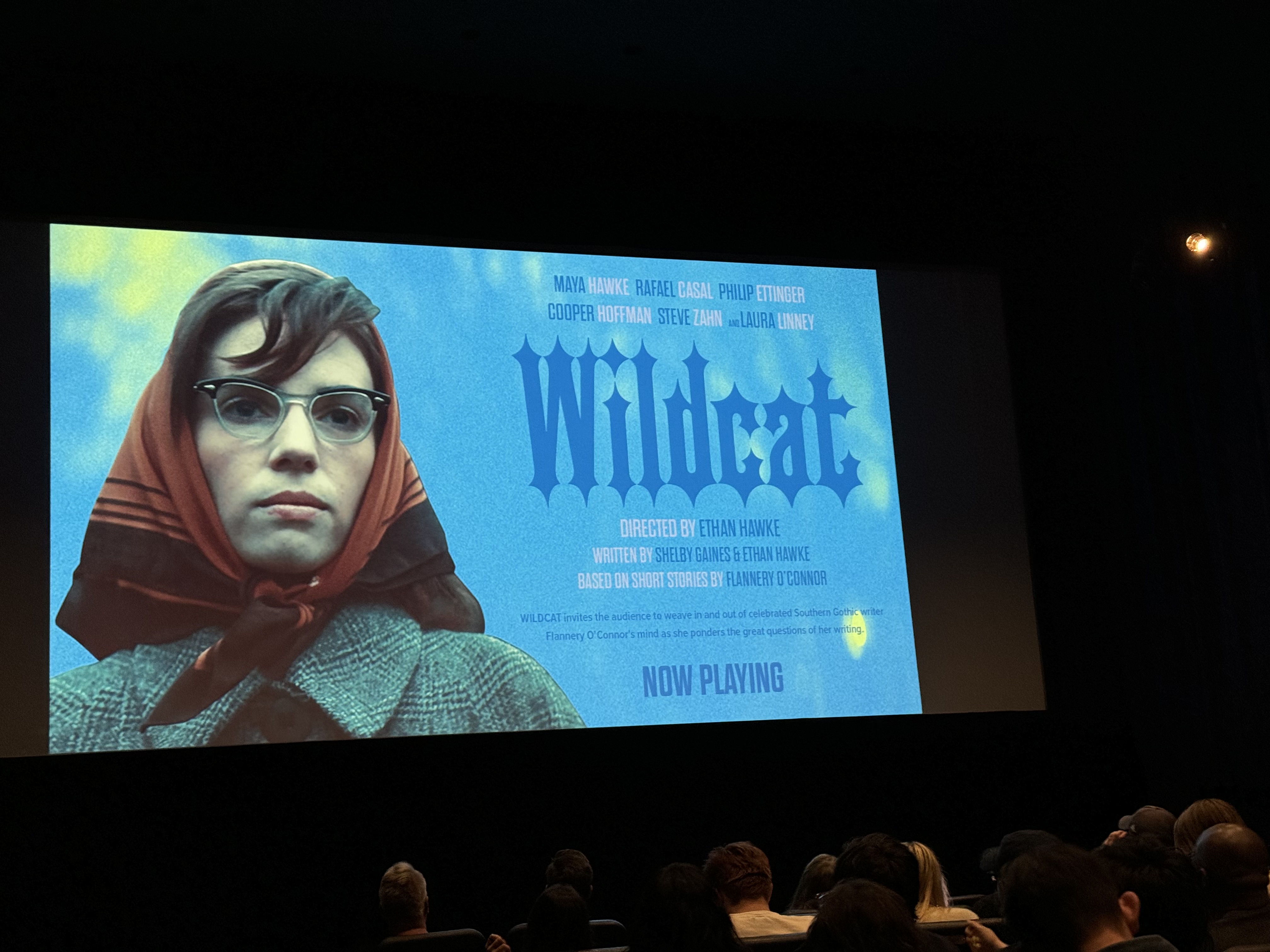
Actor/Director Ethan Hawke (Before the Devil Knows You’re Dead, First Reformed) visited Nashville’s Belcourt Theatre, May 8, 2024, to discuss his most recent movie and directorial debut, Wildcat, his 2023 biographical adaptation of the latter life and works of American, Southern Gothic author, Flannery O’Connor (1925-1964), with a discussion/question and answer forum, in tow.

Hawke attended two post screening question and answer forums in the Belcourt’s 1966 theatre that May 8th, the first showing/post-discussion at 5:15 pm, with the second at 8:00 pm, both interviews conducted by Allison Inman, Director of Education and Engagement, and to sold out audiences of solely, Belcourt members offered the chance to buy tickets prior to going on sale to the general public.
Wildcat, starring Maya Hawke as Flannery O’Connor, continued for two additional evenings without post-q&a forums, that week, at Nashville’s historic, film center.
Maya Hawke, Ethan Hawke’s daughter, was not in attendance for the forums.
-First, some area-news:
Alt. Indie Musician, Maya Hawke will make early and late show appearances for two sets at Third Man Records’ The Blue Room, June 1, 2024.
Singer/Musician (and actor), Maya Hawke, most recently of Wildcat mention at Nashville’ community film center’s, the Belcourt Theater, will perform two sets, that evening, one early, scheduled for 6:30 pm, followed by a late show at 9:00 pm, influenced seemingly, by the mid-90’s, solo, alt-indie comfort rock of Fastball.


Maya Hawke tickets are available, queue waiting-style, on the Dice app, which is found where ever your Apps are found, as well as is ambiguous about the announcement of ticket availability through the Dice app, found at your local app store.
Maya Hawke’s music can be found across the icons, but strong on YouTube, currently, with a third album, Chaos Angel, out May 31, 2024. Pre-orders are available at Maya Hawke – Chaos Angel (lnk.to).
Local Singer/Songwriter, and online presence, Molly Frances, opened her second area, solo-acoustic set at The Basement, 8th Ave., Wednesday, May 22, 2024 to include a more so modernized observation of tribulations within an area, young woman’s life, accompanied by the wholesome facial expressions of epiphanies, then-realized, during a solo-acoustic, ambient tech set at The Basement on a Wednesday -as well as her laptop.

Frances began a tip-of-the-toe test into the Nashville solo-acoustic music scene opening for Safari Room, May 22, with another show under her belt earlier in the year as she works out influences of a softer, early Taylor Swift-backed-by-angelic synth strings, and back up harmonies.
Mary Frances’ work can be found through @mollyfrances | Instagram, Facebook, TikTok | Linktree (https://linktr.com/mollyfrancesmusic), as well as her homesite, Molly Frances (mollyfrancesmusic.com).
Ethan Hawke’s Belcourt Theatre, post-Wildcat Q&A forum, May 8th, 2024:

Actor/Director, Ethan Hawke: Hey guys, how are you?

Inman: Um, I’m going to talk to Ethan for a few minutes, and then we’ll get the audience questions. It just occurred to me that I forgot to reminisce about this, but the last time you were here, we sat in this theatre and watched The Blues According to Lightning Hopkins, which you programmed for the Belcourt, and I just remember having an –you havong kind of an emotional experience watching that movie, and you took into the Blaze q&A over to the other theatre to answer questions. That was so cool.
Ethan: It was fun to be here. This is a great place. You guys are all lucky to live here, and have this amazing theater (audience applause).
Inman: This is another audience of our Belcourt members who are so certainly dedicated people, so thank you for prioritizing us, and coming here to talk to us. We talk about our fims to death. We stand around in the lobby…
EH: -Needs to be done.
Inman: Yes.
EH: -Has to be done.
Inman: It does. So, I hope that everyone will have some spirited debates about this film, and really dig into it.
Inman: One thing –We’ve been talking all night, so hopefully I won’t repeat too much, but I really appreciate the relationship that a director, or cast, might have of somebody close to them. Not just only Maya, but also, all the other great actors that you have relationships with, and I just, maybe naively, think that relationship kind of reverberates in the work.

EH: […] I remember being a kid, but realizing, like, so when you like at The Beatles, and they’re going through this height -everybody’s screaming their names- like, how do those two young men write “Eleanor Rigsby?” (audience murmur-laughs). Like, what’s going on with those two guys –all the fandom…- And you feel their friendship. I think that’s why they lasted such a long time. I think that friendship has to do with the intimacy that these friends had –Y’know, they both had lost their mother, and there was something real, and sustenant, happening in their music, and I remember once I was doing a play with this actor. We were doing a play. It was really amazing. I love doing it –blahblahblah- Meryl Streep comes to see the show. And she comes backstage, and she asks all these questions about the rehearsal process -’what did you do with the first day of rehearsal? What did you….- She really enjoyed the play, and then after about half an hour, I said, “y’know the other lead actor and I have been friends for about 25 years,” and she goes, “Oh, you cheated” (audience laughs). That’s kind of how I feel, is that through intimacy, you can get to the deep end of the pool, if you’re also working really hard. And people love to ask me about working with my daughter, and all that, but I’ve known Laura Linney longer than I’ve known my daughter (audience laughs). I’ve known Steve Zahn longer than I’ve known my daughter. I’ve known Liam Neeson longer than I’ve known my daughter (audience laughs). It was exciting to invite all… -y’know, it was like a band. It was trying to put a band together. Y’know, people who understand how you think and they understand what you’re going for, so even in smaller parts, they can kinda fit into the larger context.
Inman: Yeah. That films fun… um, …too (audience laughs).
EH: You think?
Inman: Yeah! Was it fun?

EH: (takes a beat to answer) (audience laughs)… Once you take on –once you start working on a movie about this woman, a level of responsibility starts to sit on your shoulders that’s not fun. Because she means a lot to a lot of people, and that weight doesn’t do you any good. You know you owe it to the people that loved to love her –and when you love somebody, you’re not referential. You don’t just put them on a pedestal. You touch them, you tease them, and kiss them –y’know, kiss them appropriately (audience laughs)- but you know what I mean. I had a ball getting to do something that I care so much about, but it was a lot of work. So, it was fun, but it wasn’t, like, New Years Eve fun.
Inman: Got it (audience laughs). And a lot of responsibility to get this right, I think.
And I know that you’re a fan of Robert Altman, and he’s talked about sort of prioritizing behavior in films, rather than plots, and I feel like your film is definitely in that realm of more, just –it’s working on another level that I fell is really gratifying as an audience member.
EH: I do, too. Plot is kind of a contract with the audience. People like plot. They want it –it’s like what we tune into those murder mysteries, or the half-hour corporate drama, or whatever. You love things to be tidy in that way, but our life experience is not tidy. There is no beginning, middle, or end to our life. It’s a spiral staircase of sorts, and sometimes you’re going up, and sometimes you’re going down, and sometimes going down is what leads you up. It’s so much more confusing than that, and so there’s an inherent lie to any bio pic, like that whole idea that somebody’s life is going to have a story the way a movie has a story. That’s so…
I try to make a movie about what Flannery means to me.
You know, it’s not her life. It’s our –the filmmaking… -the team of people making this film- it’s our collective hit on how she vibrates off us, today.
Inman: Do you feel like a Southerner. I know you were born in Texas, and spent time in Atlanta, but you also are a little bit detached from the South, as well. How do you relate as a Southerner.
EH: Now, you’re putting me in the shrink’s chair (audience laughs), because –my parents are from –I was born in Austin, TX, and they’re from the South. My mom left, and brought me with her, and so I would spend the summers in TX, and my mom traveled around, and sometimes she lived in GA, so –and when I first moved to Brooklyn, as a teenager, y’know -I’d -they’d asked me to introduce myself to the class –y’know, ‘introduce yourself to the calss, ETHAN- and I’d thought it’d be fun to sing ‘Jambalaya,’ for everybody (a few in the audience gave an empathetic laugh to that one).
Inman: How’d it go?
EH: Yeah, I got my ass kicked when I got there. That did not go over well at all. So, I have a strange relationship with the South, that is I love it. That’s what I associate my father with, and I always want to be there, and then –but- I was largely educated in the North, and so, I think it –I gravitate to liking, -y’know, Blaze is about the South. Everything I’ve ever written myself is either people on their way to the South, and it’s (started realization-laughing) -it’s somehow a big part of my subconscious. I think it’s actually a blessing for me. Y’know my father was very conservative, and my mother was very progressive, and I grew up in a house that saw both sides of the equations, and it left me as a kid feeling really confused, but I appreciate it, now.
Inman: Yeah. I’m sure that that helped you, actually, just those two things.
EH: One of the best compliments I ever got about this movie, my mother was living in Atlanta, GA when she gave me a Flannery O’Connor stories, and everything, and –I hate to admit this, but you can’t talk about Flannery O’Connor without talking about race in America, right? It just comes up. I think it’s important, and I love it, but when I read “Revelation,” -the story in the doctor’s office, y’know? (referencing the movie we’d just watched)- It was like my grandmother. That was my grandmother talking to me as a kid with the little… I even put the little, ‘Can you believe they’re translating the bible into Spanish…’, because that was said to me, y’know [and] you’re like, ‘wait, it wasn’t written in English, grandma’ (audience laughs).
Flannery’s so hip to that hypocrisy, y’know? I really related to that.
The movie played a situation like this in CO. I wasn’t there, but Laura Linney was at a screening in CO, and my mother’s best friend from the third grade got my email and wrote to me, ‘Was that a portrait of Rosa Lee?” (audience laughs)
“Don’t tell anyone!” Hawke said.
But, that was… –so, it’s like… Do I relate to the South? Yes (audience laughs).

Inman: It’s kind of hard to live the South down, though. I mean… I feel like -I think Flannery O’Connor has also expressed something. It just felt people’s hatred for the South is, y’know…
EH: Well, people don’t understand a lot about her writing that I love was how allergic she was to virtue signaling: […] this idea we play this moral high ground to judge others.
I played John Brown a couple years ago in this Showtime series The Good Lord Bird, and one of John Brown’s big problems –he was as angry at the North as he was the South, but their hypocrisy of morale judgement without doing anything about it. And when I think of when Flannery would go North -when she would go to college- she would feel so heavily judged as a Southerner, she always took the contrarian position to any situation.
Inman: I wonder how she would’ve evolved if she would’ve lived to be an old woman.
EH: I would’ve loved to have seen that (sweetly). It would be so –when you realize she died at 39, and she hadnt’ really left the house much for the last fifteen years. Y’know -and what a brilliant mind. This is a woman -She grew up less than three miles from Alice Walker, right? Alice Walker used to walk by Flannery O’Connor’s farm, and they never met. And I always. These are two of the greatest literary minds in America –y’know, in the last century of American letters, and it’s so “our country,” that they would’ve never been introduced to each other.
Inman: I also always forget that she died young because Flannery O’Connor’s writing, and even just hearing her voice, always sounded like an old woman to me (couple people chuckle).
She was a little bit like –I was friends with Philip Seymour Hoffman. I starred with him in this ovie, and everything, and Philip was one of those 24 year old that was like 24 going on 62 (crowd laughs). He doesn’t wanna… “Yeah. How’s it going?” (Hawke gruffly impersonates Hoffman), even when he wasn’t…(crowd laughs).
Flannery has the same. She seems… It’s what’s part of me I think that drove me to make this movie because my mom would give me these stories, and you’d read them, and it it felt like you were reading Charles Bukowski, or something. It was so wild, full of sin and vice. You’d look at the back jacket and it’d look like poor, sick Emily Dickenson, or something (audience laughs), y’know? But out of this imagination was this wildness in that, in congreguity –I can’t. I won’t even say that word again because I won’t say it (audience laughs)… -always was hypnotic to me, like, ‘where is she coming up with all this?’
Inman: Yeah, also I had this feeling that people were not hip, at all, or dark, at all. I feel like everybody was jusg a square until, like, the seventies, or something. And, so to know that this young Catholic girl had such darkness in her, such complexity in her. That’s the mind-blower for me in this whole experience, and I can’t wait to go read everything else, and read what all the other scholars have had to say about her. I know Tony Morrison has written some great stuff, and I’m just… I love that feeling when I watch a film where I cannot wait to go study mofre. Read more.
EH: Well, I’m sorry that you’re saying that, because whenever other people hear that… -Whenever people think hey have to study to watch a movie…
Inman: That is un-… Study is nice.
EH: –I’m like, my hope is that we studied so you don’t have to (audience laughs), but I also hope that people want to read her, too. I do.
Inman: Stuuudy is the wrong word (audience giggles), but you know what I mean…
EH: Enjoy!
Inman: I want to dig in, Yes.
EH: Baaathe in Ms. O’Connor’s work…
Inman: I want to Party with her work.
EH: I don’t know what a party it’d be (audience laughs). I joke to people –especially her last novel’s called The Violent Baren Away, and I would say it’s the greatest novel ever written that I would never recommend (audience laughs). It –It’s, ah… She’s so brutal, her willingess to look at our hypocrisy is unending, and it’s a deep, deep well, and it’s one of those books that when you read it, you’re better for having read it, but it’s kinda like the school messed up putting it through the ranks.

Inman: Yeah. Let’s get some audience questions. Raise your hand, and we’ll come to you.
Gentleman, middle seats, a quarter of the way back from the front (~20 ft.): Hey. Really enjoyed the film. I have a question about directing actors. It’s kind of a two parter.
The first, obviously as an actor -and an accomplished actor like yourself- is it easy, or do you have to kind of wear two hats when you’re directing? Do you sort of go, ‘this is my approach as an actor,’ versus, ‘no I’ve to my director’s cap on/it’s a different approach?’
And secondly, I know Allison kind of touched on this: The familiarity with, obviously, your daughter. I have a daughter. She’s almost exactly 21 years younger than me. I can’t imagine as I’m watching/projecting myself, kinda, onto this experience, -or your experience, I should say- and kind of wondering, like, ‘we have our inside jokes,’ ‘we have our very specific dynamic,’ ‘we have our life at home…’ Did that ever bleed through onto the set? Was it ever, y’know, ‘I’ve got my dad hat on. Oh, wait! I’ve got put the director cap on,’? Was that kind of easy to slip into, or was there a hard boundary of like ‘no I’m a director, not a dad.’
EH: Umm… First off, the actor part of it, I started acting so young, and I such a -had a couple of great experiences as a young person, particularly on Dead Poet’s Society, it was kind of a masterful director created a really wonderful working environment that felt so creative and spontaneous, and I thought that’s how making a movie was like. And then you do ten years of something, and you realize it’s usually Not like that, so my interest in directing was trying to give –to create a set- where actors could be creative because I so often felt directors had an agenda: ‘stand there,’ ‘say it like that,’ ‘this is our shot list,’ whereas Peter Weir had never done that. It was this collective, imagination experience that he guided us. Really, really wonderful, so I like to give actors their own power. That’s what started to drive me to direct. Later, I started falling in love with the medium, about what is editing? What is photography? -What is cinema? How is it different from other artistic mediums?
And in regards to Maya, it is funny, a lot of our releationship went into th… -This was her idea to make this movie. She had fallen in love with Flannery. She came, and approached me about this. She had read The Prayer Journal, which is a small book that was published recently, actually, of her letters to God, circa ‘18 – ‘21, and largely trying to figure out how to reconcile this giant ambition in her heart with an instinctual desire for humility that seemed at odds with that, or desire to be a good Christian; to see yourself in service of others. She didnt’ want to make art to try to make herself seem fabulous, but did want to make something brilliant. And does that speak ill of me? I think for Maya to be blown away by the arc, and then to fell the insecurity vibrating off these journals, and also to see another woman struggling with ambition, and I think more so, for women than for men, ambition is often seen as, kind of, an ugly trait. She was trying to reconcile all that, and that was personal for Maya, even the… So, when she came to me wanting to do this –and I’m sure all of you with young people in your lives, a lot of times young people come to you with these questions –these big, big, serious questions: What is society? What’s fake about it? What’s faith? What’s God? Why do I have to die? Why do you have to die? What’s going on? Why aren’t you thinking about this All the time? (audience laughs), you’re kinda left much like the Liam Neeson character in the movie, left with kinda just wanting to put your hands on your head. That whole scene is drawn, yes, out of Flannery’s work, but also about my whole experience about trying to raise Maya, y’know. I mean, she’s a force, and her brain is asking all these questions that I don’t have the answers for. I know the questions are valuable, and I want her to ask them. I just want her to be more gentle (audience laughs).
Y’know?
And so, the whole idea of making this movie is a long conversation between Maya and I about is human creativity an act of worship?
I went to church my whole life: Baptized, confirmed, my mom was a youth group leader. This is a big part of my childhood. I didn’t do it with her. She said, ‘why didn’t you do this?’
And I have reasons that are complicated, and it started a long conversation, ‘well, I didn’t give you that, but I have given you Emily Dickenson. I have given you Louisa May Alcott. I have given you Tolstoy. This is where my authentic worship comes into play, and so we could’ve made a movie about, does all thought lead to action? Is Miles Davis playing a prayer? -I always thought it was, because it feels like what I wanted from praying. And so, can we extend that conversation, and can we have it with you?
Is literature –is movies- is it a form of worship? Is looking at your context, -seeing your own hypocrisy- is that valued? I think it is. And so, I don’t know about you and your daughter –I barely know about me and my daughter. I can’t figure that out (audience laughs)- so that I know that building on something real. And the one thing that was awkward about it is there were no men in Flannery’s work. Y’know, she lost her father, really young. Her primary relationship in her life was with her mother. There’s kind of this absence of the male figure in a lot of the work, and when you see men… -out of focus… Primary relationship is a female… It’s -there’re are some remarkable stories that expand beyond that, but that’s what I took away from it. So, it’s interesting to engage with her –y’know it wasn’t a movie about a father and a daughter. It was about… And this was very important to Maya. She grown up showing me her movies about men’s relationship to themselves. Men are going to write their paper, they’re going to win the Pulitzer, or they’re gonna win the game. It doesn’t matter what a wife says, or their kids. She wanted to make a movie about a young woman’s relationship to herself. And I kind of took that as a challenge, and Steve Cosnes, who is our cinematographer –who I love, who I’ve have worked with a bunch before- she really consents to us, ‘all I ask of you guys is to try and channel your female gaze’ (audience laughs)… ‘just try to channel that.’ Because we watched this movie –you metioned it earlier- there was a great Jane Campion movie called, An Angel at my Table, that I saw when I was madly in love for the first time –I was about 21- and it was the first time I’d really seen –it was a movie where the men were all out of focus. They didn’t matter, and when they talked, they said the stupidest things (audience laughs). Y’know, they didn’t really matter in the story. And I realized that -because I was in love with this woman, I realized, ‘oh, the movies she’s been watching were all, like, where the women were out of focus, and it was a powerful experience to drive for Steve and I to try and channel Flannery’s gaze.
“That was a very long, meandering answer,” Hawke says (crowd murmurs and laughs.
“I appreciate that answer. Thank you letting it go long,” said the next questioner, handed the mic by a roving Belcourt mic-hander.
EH: (laughs).
2nd Questioner: And to add to your point –or hope- that film, or that writing, can be a prayer, I say, ‘yes.’ I believe it.

2nd Q&A’r: My question is, as a writer of this film, you’re writing dialogue for a writer. How much of that is Flannery’s writing? Have you adapted that?
EH: Yeah. I appreciate that. I have a partner, Shelby Gaines, who I… he –people don’t know this, I think it’s incredibly rare in the history of movies that the writer of the screenplay also did the music. And he’s a musician and we became friends through a friend who is here tonight, […] but his –it was wonderful to have somebody compose music who actually understood the DNA. This is [mercurial?] screenplay, but he understood exactly how this fever dream was supposed to work, and it was really wonderful to have happen.
What we largely decided to do with her in –and this was Shelby’s, one of his great insights- after spending… it was about six months of trying to read everything… you think, ‘this woman is beyond us’ (audience laughs).
“She’s a heavyweight,” and he said.
“And we have to kind of let her write this movie.”
So, we built it out of her writing. The voice overs were her Praryer Journal. A lot of the scenes with dialogue are taken from her letters; obviously, pieces of her short stories, but we blur the short stories. If you read some of the short stories, we’re blurring –we’re taking lines from some of her letters, and putting them into the short story, because this movie ends before she’s ever published. In my mind’s eye, the movie really starts at the end. Like, it’s, ‘all these stories are dreams, right now. They’re not finished entities,’ so we were trying to dig for, ‘where do these stories come from?’ -The most obvious example being at the end of the scene with Liam Neeson when he says, um, y’know -if she’s in a fever the whole movie, it breaks in that scene- and then he says, ‘and then now, for a proper confession…’ -and we just picked her most confessional work. Which is the one about getting, y’know –it’s autobiographical. It’s pretty obvious. She’s on a crutch. The main characters got a wooden leg. She’s looking down on everybody. She’s changed her name from Joy to Holga. She’s scared she doesn’t believe in God, right? It’s a confessional. And it’s -she’s spent much of this movie scouring other people, and now she’s scouring herself. This bible salesman Is a turkey. He Is a conman. But she thinks she can play him. But she gets played. Because of her arrogance. And that seemed like an entrance to humility, y’know? Something I find really moving at the end of that story. So, we really just try to let Flannery tell her own story.
Q&a’r #3: Hello. So, there’s some repeating imagery with the crown of thorns a couple times in the movie, and I couldn’t help but find it aesthetically similar to First Reformed, so I was wondering, if -specifically in the context of Christianity- how that movie might’ve informed this one.
EH: That movie had a heavy experience on me, First Informed. I made this film with Paul Schrader, who’s a brilliant writer. If you haven’t seen it, it’s very dark, very challenging movie about a priest, and Paul loves Flannery O’Connor, first of all, and I learned –y’know, you learn somethings acting for somebody, but really what we would do the press tour, and when we did events like this, I really learned how he thought, and he used to say this thing that, ‘a really good movie will start when the end credits roll.’ ‘That people want the movie to put you to sleep.’ -You just don’t have to think, and then you then you can walk out into your life. And what he wanted to do was make a movie that engages you, talks to you, and makes you think, and then it ends, and then you go out and have your experience with the movie. And he doesn’t like to dictate to you what the movies about. And he creates really challenging photography and really challenging dynamics to hopefully invite you to participate with him, and I was really moved by that. As an actor, I’ve done some Brecht plays, and things like that… As an actor, there’s always something phony, the violins playing, and the close up of the tear, and the lights –[Ethan Hawke mouths sound effects of positioning of stage lights in his mind] <dah, dah, dah> -and everybody is told exactly how they’re supposed to feel. There’s something exciting about open symbols.
And yes, Paul is a Christian, and Flannery is extremely devout in her faith. And what she did that was remarkable and so different is she worked on her own faith, and made meaningful, substanent art using the insight her faith gave you not to preach to the choir. She’s not –she’s no agenda. -You can have your own relationship with the divine. She didn’t make you. She’s fully aware of her faith. She’s barely in charge of her own inner life. Right?And so, I found that really exciting because I think that her faith brought her to some very deep wells of thought about life, and what grace is. -What do we mean by that word? And so …but -You cannot avoid Christian imagery with her writing. I mean, from the burning [tree] when Parker drives his tractor into the… I mean, that’s a whole Moses… I mean, there’s so much imagery in the movie. She’s hiding all of her symbols, and –but, people love to think of these parables, these stories of the bible as these myths and legends to be learned from and studied, and everything, but they miss, like –I saw somebody on Twitter the other day say, -and nothing of this movie- but they just said, ‘wow, imagine a real estate mogul whose running for office, whose selling bibles to pay off a porn star. Sounds like a Flannery O’Connor short story’ (audience laughs), and see? These stories, biblical in reference, are completely relevant. They’re alive in our daily lives all the time, and we life to set them apart as ‘this other thing’ that maybe we could learn from, as opposed to feeling them in our bones about what is sin, and what is communication, and what is loving, and what is compassion, and what is not. I find that imagery very powerful and it creates a depth that we tried to conjure in the photography.
Inman: Let’s do one last question to close out.
Q&a’r #4: It was a great movie, and I really enjoyed it. I was just curious, Flannery, in the movie, is projecting herself on a lot of the characters, and I was wondering did you feel yourself projecting yourself onto, like, Flannery while writing this, and which of your own traits would you feel was Flannery, I guess?
EH: I’ve always known that I’ve felt from a young age that our experiences aren’t as unique as we think they are. We experience them, becuase when we’re talking about the grief of a loved one, or divorce, or parent/child relationships –all these things that seem so specific to us, are easily accessible if we share our truth, y’know. A lot of us have experienced mental illness, and illness of friends. These things that fell like secrets –things to hide, things to not reveal- once revealed, you see how like-minded so many people are. And the actor in me is always trying to find, ‘how am I like this character?’ ‘In what ways could I…?’ ‘If I were born here…?’ ‘If that had happened to me…’ ‘If I’d had her experience…’ But, the main one for me, with Flannery, is how to live a substenant life in the arts. I mean, it’s the essential question we start talking about from the prayer journal. I mean, lots of people get rung up the flagpole and given lots of money and prizes who haven’t contributed. Lots of people who don’t get that have contributed. Some people who do have -You have to have your own metric for how to live your own life. You can’t look for it externally, and she’s an amazing example that’s faced with illness and rejection over and over again, and her pursuit of excellence is tireless.
I mean, not only is she finishing her final novel, she’s rewriting the first story she ever wrote. She’s redrafting it. Her obsession with what excellence could be, and how nothing is good enough was inspiring to me. And, I’m not saying I’m like it, but I admire it. And, I think I love spending time with a person like that because it’s good for me.
And I also really enjoyed sharing the movie with people, and I appreciate your time being here, seeing some weird movie like this (audience laughs), and being here with me and talking about it.
And I’m so grateful for you for running this theater, and getting people to care about movies and be together, and building this whole evening for us (crowd applause).

“Members provide vital annual support for the nonprofit Belcourt Theatre and its innovative film programming. As a member, you’ll enjoy a range of great benefits that include discounts on film tickets and concessions, member only invitations (including no service fee for online ticket purchases), and the inside scoop on upcoming events,” states the website.
Basic membership levels include the Individual level ($50/$40 Student and Senior), Dual level (&80/$70 Senior), and Family level ($100).
The Belcourt Theatre is located at 2102 Belcourt Avenue, Nashville, TN 37212, with contact to the Main Office at boxoffice@belcourt.org (for general inquiries), or by phone at (615) 846-3150, though they’ve retired some of the options, as found.
For more information, including the daily and weekly “In Theatre” schedule; events including Holiday classics, Belcourt’s Restoration Roundup, more Rental Events, among the options; anything on Belcourt’s Education and Engagement Program, headed by Allison Inman; The Belcourt Stories Project; and Belcourt Affiliations (camradaries), visit belcourt.org.


Leave a Reply